KARAMOJA NEWS Truth All Day
Related Articles
By Timothy Eodu-Moroto

As Uganda prepares the National and District Budgets for FY2026/27, Civil Society Organisations-CSO’s working in Karamoja have united to call for urgent and targeted investments in service delivery for the sub-region. Karamoja remains Uganda’s most marginalized area, with poverty levels rising sharply to 74.2% as per the 2023/24 Uganda National Household Survey, three times higher than the national average. The region also records the lowest literacy rate in the country at 25.4%, persistent food insecurity, and chronic underfunding in health, education, agriculture, and infrastructure.
Despite these glaring disparities, Karamoja receives 17% less per capita budget allocation than the national average, and only 19% of its district budgets are directed to development spending. The result is weak service delivery systems, under-staffed facilities, and limited opportunities for youth and women to thrive. This press statement outlines our joint demands to government and Parliament to prioritize Karamoja in the FY2026/27 budget.
According to Jonas Mbabazi Musinga, the programs’ manager at Advocates Coalition for Development & Environment-ACODE, the education sector in Karamoja faces a staffing crisis, with some schools operating with as few as five teachers for more than 1,000 pupils. Over 60% of primary schools lack teacher accommodation, contributing to absenteeism and low retention. Many community-founded schools remain uncoded, preventing them from receiving government support. Dropout rates are among the highest in Uganda, with more than 50% of learners leaving school before completing Primary Seven. (P.7).
Musinga applauded Government for its initiatives in the National Development Plan-NDPIV, which he arged that when utilied effectively beyond documentation, the plan is capable of answering the questions being rasied because they are tailored to solve problems directly affecting the local populations. He called on the govenment to ensure transparency and accountability in order to achieve meaningful transformation among communities in Karamoja.
Meanwhile, Emmanuel Lomonyan Lopir, an accountability champion with MUCOBADI stated that in health, Karamoja has the highest number of un-upgraded Health Centre IIs in Uganda, forcing expectant mothers to travel long distances for deliveries. At Kalemungole HCIII, only 12 of the 53 required staff are in place—a stark example of chronic understaffing. Facilities often lack electricity and water, and chronic drug stock outs, making it impossible to provide safe maternal care.
Selina Auma, the Director of Programs at Karamoja Women Umbrella Organisation-KAWUO urged that women in Karamoja are disproportionately affected by poverty, gender-based violence (GBV), and poor maternal health and over 60% of women in the region have experienced GBV, while maternal mortality remains nearly 50% above the national average. She added that district budgets allocate less than 2% to women-focused interventions and emphasized that investing in women is not charity but smart economics, therefore demanding an increased and ring-fenced funding for GBV prevention, maternal health, and women’s livelihood support, institutionalization of gender-responsive budgeting at district and national levels and active and meaningful participation of women in all stages of the budget cycle.
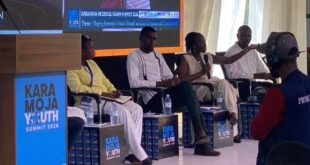
On unlocking youths Potential for Peace and Growth in Karamoja, Henry Napokol, the Programs coordinator for restless Development stated that, Karamoja has the highest NEET (Not in Employment, Education, or Training) rate in Uganda, estimated at 60–68%, with youth unemployment above 40%.
He said many young people remain trapped in vulnerable employment, cattle rustling, or are drawn into inter-clan violence and the Civil society partners call for creating Regional Youth Skills Hubs linked to existing TVET institutions, micro-grants for youth enterprises, and structured youth peace teams integrated into local government peace committees.
He suggested that the budget must allocate resources for youth-friendly health services, climate-smart livelihood programs, and infrastructure (roads, ICT, and safe recreation spaces) to reduce idleness and build social cohesion, reintegration of support with robust accountability for financial and material aid and towards livelihood programs for the youth, including vocational training and business support, tailored to the skills and needs of reintegrated youth and the broader youth population
To Dorcas Akot, the Riam-Riam programs officer, Women’s and youth voices remain significantly underrepresented in governance and budgeting processes, particularly at district and sub-county levels and this exclusion limits meaningful resource allocation and accountability, resulting in budgets that do not fully address the urgent needs of young people. She highlighted the need for transparency in budget implementation, improved procurement, and timely disbursement of funds.
The CSO’s jointly demanded that government, Parliament, and development partners make FY2026/27 the year of equity by increasing budget allocations to Karamoja in line with its disproportionate poverty and service delivery needs, ring-fencing resources for tailored education, health, women, and youth programs for the sub-region, institutionalizing gender-responsive and youth-inclusive budgeting to ensure that issues of women and youth in service delivery are adequately addressed and strengthening accountability to ensure every shilling benefits the people.