KARAMOJA NEWS Truth All Day
Related Articles

By Cinderella Atenyo-Moroto
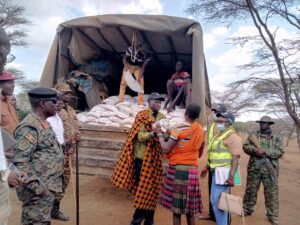
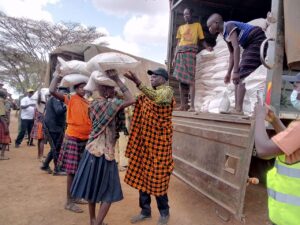
The Minister for Karamoja Affairs, Hon. John Baptist Loki , stood before residents in Lokisile Parish, Lotisan Sub-County, Moroto District, and delivered a firm pledge: no one should die of famine in Karamoja again. On Saturday, government teams distributed 13,520 kilograms of maize flour and 6,760 kilograms of beans to 676 households in one of the hardest-hit areas of the district.
The Minister told beneficiaries and local leaders that the current food relief exercise would continue until every household in the sub-region is covered. Eight of Karamoja’s nine districts have already been reached under the ongoing operation.
The assurance comes against a stark backdrop of a prolonged dry spell that began after the first week of May 2026 and has caused widespread crop failure across the semi-arid north-eastern region. Staples including maize, sorghum and soybeans withered in the fields. At least 19 people have died from hunger-related causes, according to recent reports, while an estimated 473,000 people—about 32 percent of the analysed population—face crisis-level hunger or worse.
Nearly half the population in Kaabong and Kotido districts is in a critical malnutrition situation. Health facilities continue to treat hundreds of children for severe acute malnutrition. Across the region’s roughly 1.5 million people, acute food shortages and rising malnutrition have become the defining reality of the 2026 lean season.
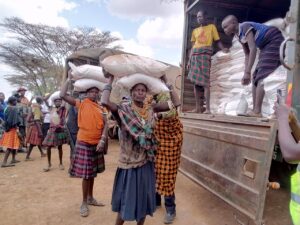
Moroto Deputy Resident District Commissioner Justin Tuko used the launch to warn beneficiaries against selling the relief food, saying anyone found doing so would be arrested and prosecuted. Lotisan Sub-County LC3 Chairperson Akiki John Robert Adupa explained that 676 of the parish’s 750 households received food; others missed out because they were away in the kraals or lacked National IDs at registration time but plans are under way to include them in the next phase. Residents who received the rations said the food would help them survive the remaining dry months.
Environmental Pressures and Structural Vulnerability
Karamoja’s recurring hunger is not a sudden shock.
The region is highly exposed to climate variability. Erratic and failing rains, prolonged dry spells, deforestation, overgrazing and land degradation have steadily eroded the natural resource base that agro-pastoral communities depend on. Water sources for both livestock and crops remain unpredictable. Soil retention is poor.
The result is low agricultural productivity and a population that remains heavily dependent on a single, unreliable rainy season. Experts and assessments repeatedly link the cycle of food insecurity to these environmental drivers combined with poverty, limited market access and historical under-investment in climate-resilient infrastructure.
A History of Interventions That Fell Short.
Government and partners have launched repeated emergency responses and development programmes over the years. Yet many water-for-production projects—critical in a region where water is life—have under-delivered. Valley tanks often dry up within weeks or months of construction. Larger dam projects such as Nakonyen have stalled or fallen into disrepair after significant public investment.
Shallow facilities and poorly sited or maintained infrastructure have left pastoralists and farmers still travelling long distances or competing for scarce water points during droughts. Restocking programmes and other livelihood interventions have similarly struggled with follow-through, adaptation challenges and accountability gaps. These shortcomings have left communities repeatedly exposed when rains fail, turning what should be manageable dry seasons into humanitarian emergencies.
Immediate Response and the Shift Toward Resilience.
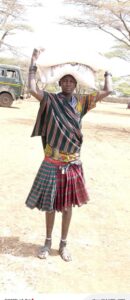
The current emergency operation is the largest government-led food distribution in recent years. Parliament approved approximately Shs 45 billion for the purchase and delivery of more than 9.4 million kilograms of maize flour and beans, targeting nearly 314,000 households across 480 parishes in the nine districts.
Distribution is being coordinated by the Office of the Prime Minister in partnership with the National Enterprise Corporation, the Uganda People’s Defence Forces, Uganda Prisons Service and local governments. Ministers and technical teams are overseeing the exercise to improve transparency and reach hard-to-access areas. Drought-resistant, early-maturing seeds are also being prepared for distribution ahead of the expected August rains, and Operation Wealth Creation is mobilising planting materials.
Leaders stress that handouts alone cannot end the cycle.
The recently approved Karamoja Regional Development Plan (KRDP) 2024/25–2034/35 provides the longer-term framework. Costed at an estimated Shs 15.1 trillion over ten years, the plan aims to transform the region from a subsistence agro-pastoralist society into a commercially productive one and to achieve a peaceful, productive, socially and economically resilient Karamoja by 2035.
Its strategic priorities include consolidating peace and security; developing livestock and crop production with a focus on value addition and market orientation; expanding sustainable water sources for production (including multi-purpose dams and bulk water transfer concepts); restoring rangelands and forests; improving land administration; and strengthening human capital and infrastructure.
Flagship ideas under discussion include construction of larger water storage facilities, promotion of modern pastoralism, climate-smart agriculture and better integration of the Parish Development Model with local realities.
Minister Loki’s statement in Lotisan therefore carries dual weight. It is both an immediate guarantee of continued food support through the current crisis and a public commitment that the emergency must be the last of its kind.
Whether the combination of disciplined relief delivery, seed support and faithful implementation of the Regional Development Plan can finally break Karamoja’s long cycle of drought, crop failure and hunger will be measured in the seasons ahead—not only by the absence of famine deaths, but by whether households can produce and store enough to weather the next dry spell without emergency handouts.
Timothy Eodu – Contributor